

Humans, in their essence, had been characterized by living independently. Like every living soul, they were threatened by competition, an issue that made them form into societies to guarantee their safety. These events were proposed and studied by several philosophers, who argued that the elaboration of a social contract – one that imposes boundaries on human behaviour – would allow everybody to obtain advantages from it. However, this scenario of mutual prosperity is not currently seen. The global economy, yet interconnected and evolved, hosts intense disputes, mainly during crisis. The development of the Industrial Revolutions is crucial to comprehending the reasons for that.
By the end of the Middle Ages, a series of transformations in Europe allowed the appearance of governments based on absolutism and mercantilism. The Catholic Church’s monopoly on intellectual knowledge came to an end, so scientific and technological research was enabled. The major consequences of this, from an industrial point of view, had their apex between 1765 and 1777, when James Watt created the steam engine. His invention was largely used: it transformed coal in primordial resource to every national economy. That was the beginning of the emission of air pollutants, which would later be accused of intensifying the greenhouse effect. The world development was, although followed by environmental setbacks, seemingly inevitable.
However, the development allowed by Watt’s technology did not benefit all countries. The United Kingdom, for instance, had a leading role in the First Industrial Revolution. It’s abundance of natural resources in its territory, the advantages obtained by unequal deals with other states (as the Methuen Treaty) and the consolidation of bourgeois power contributed to the English pioneering. Indeed, there were other people who could enjoy the marvels of industrialization. The hugest possessors of coal, in Europe, prospered, as well as cities now recognized by its urban excellence (Paris and Berlin, notoriously). The revolution of the eighteenth century had almost no impacts in America, Africa and in South Asia.


Nevertheless, the changes experienced in posterior decades still maintained the hope of a true supranational advance on development. Karl Marx’s revolutionary ideas were propagated, justified by the poor quality of life which affected factory workers. They were subject to an abusive routine that disrespected human dignity. In the second half of the nineteenth century, petroleum appeared as an alternative to the diversification of the fuels used in production. This combustible substance would later be responsible for the foundation of automotive industries. In addition, this period was marked by imperialistic disputes, which have strongly contributed to the establishment of the old global division of labour. All scenarios pointed to a transition in the course of mankind: social, economic and political aspects of it were frequently altered.
Those challenges to the previous industrial model culminated in the Second Revolution. Actually, some experts repudiate this nomenclature. According to them, there was only an improvement of the conditions in the first revolution. Petroleum exploration became viable and led to the production of the internal combustion engine. From this innovation, and also the concepts of Frederick Taylor, Henry Ford was able to consolidate his company as one of the largest. The Taylorism – which advocated the use of hierarchy on production – was applied by the American executive, who standardized his products so as to ensure massive consumption. One of the most important symbols of this posture was his allegation that his car “is available in any colour, as long as it is black”. Uncontrollable production, exaggerated consumerism, exorbitant profits: this Fordist logic appeared to be endless.

On the other hand, the Americans who followed Ford’s doctrine disregarded its subsequent adoption by European countries, after they from World War I. Throughout the 1920’s, global industrial production had increased so much that it surpassed the levels of consumption. This scenario of super production and lack of available consumer markets led to the crash of the New York Stock Exchange and to the Great Depression in the US. Given the fact that the United States already was a global power, the issues affected other lands and formed the 1929 economic crisis. Its main consequences were the following:
- The Welfare State was exalted, to the detriment of economic liberalism.
- The standardization and durability of the products became issues to larger corporations.
- The costs to maintain an active work force in every factory have surged.
- Therefore, the Fordism collapsed.
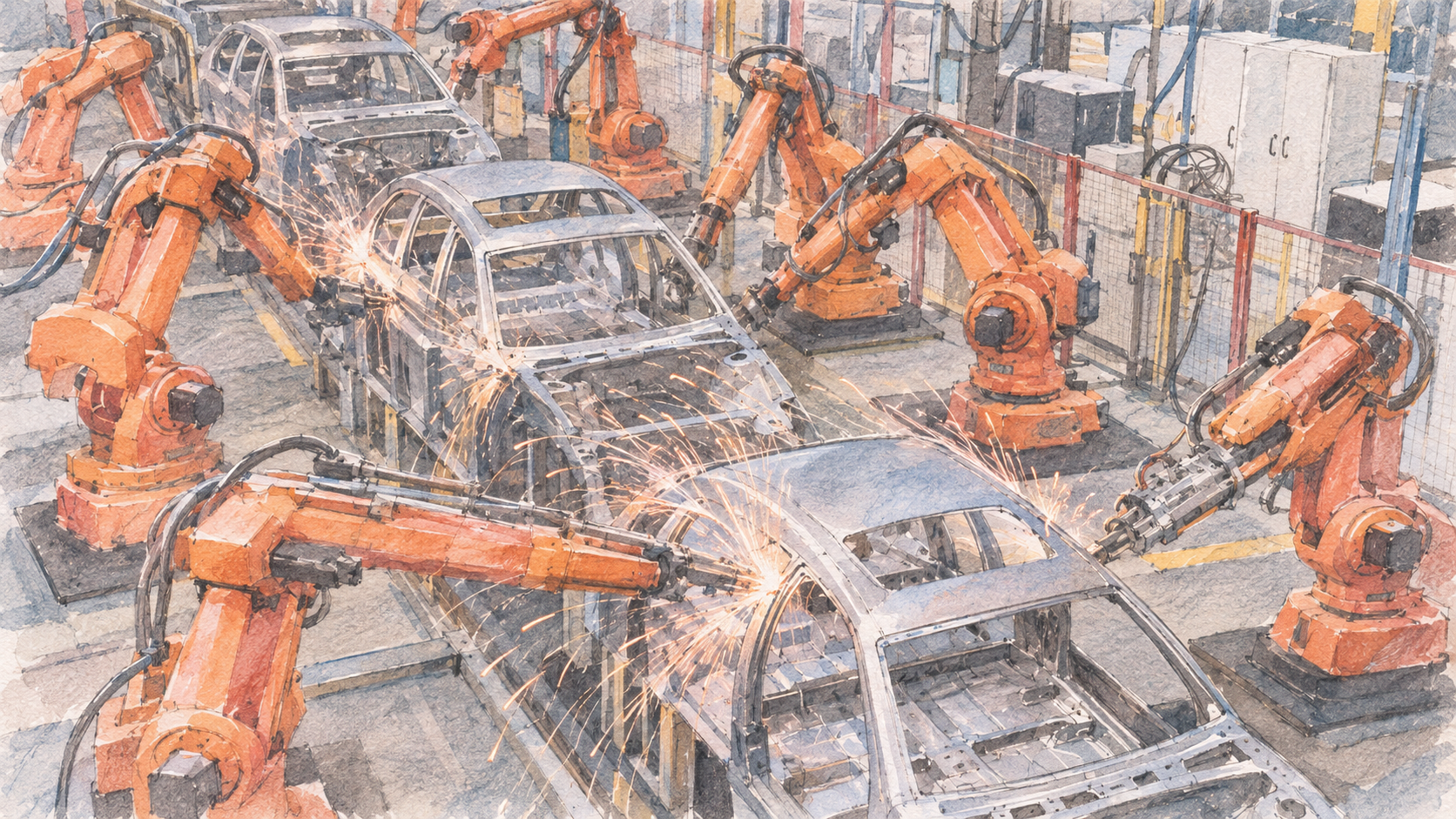
Meanwhile, another model began to prosper in Asia. The enterprise that succeeded in developing a new way of producing – Toyota – is responsible for its name, the Toyotism. By taking advantage of the Japanese technical know-how, the corporation introduced robots in the assembly line. This approach represented an utter change to Ford’s ideas: the worker shall not be specialized and alienated, but qualified to operate such complex machinery; the products can be customized, in order to correspond to people’s expectations; the production is controlled, there is no need to exceed.
The auto-maker’s proposed innovation happened in opportune moment. The increment of the means of communication and transport has enabled greater global integration. That is why the industries, previously concentrated, can now spread across different regions, as long as the places have all required infrastructure. Due to its efficiency, the reality implemented in Japan was widely adopted. It comprises the Third Industrial Revolution, or the revolution of the techno-scientific-informational means, which has still not ended. This process allows, yet in an abusive way, the expansion of industry across peripheral countries, that are responsible for less complex parts of the production chain.
Global economy has evolved throughout several centuries from discoveries which consolidated the path to success. The contemporary world, characterized by the process of globalization, praises the connection of every financial centre. During periods of growths, this global village must be protected by neoliberal concepts. In times of crisis, as the one experienced since 2008, this interdependence becomes a villain. The question is whether the recent crisis will bring about lasting changes in the way we produce.
Originally published on thimabi.wordpress.com.