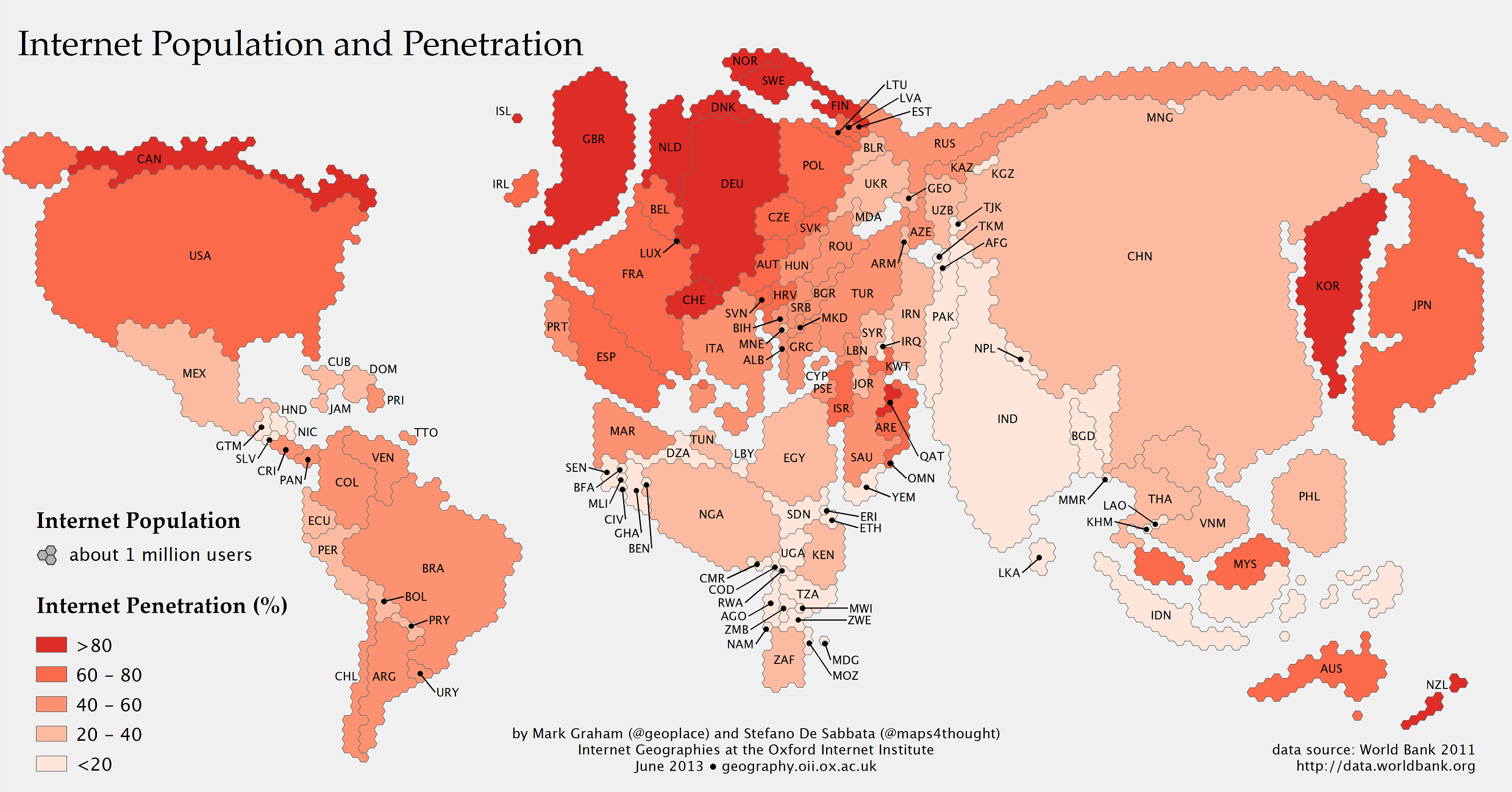

As of October 2013, I have enrolled myself on a MOOC (Massive Open Online Course) offered by the University of Texas at Austin through edX. The classes will cover many aspects of globalisation, and I am expected to write 11 essays in order to pass. This is the second written assignment I have done for the course. It explains the possible advantages or disadvantages to the creation of a supranational institution to administer the Internet, and concludes that the former outweigh the latter.
Contemporaneity has been characterised by manifold changes to the way the world integrates, epitomised by the globalisation process. The advent of the Internet – far more than other tools, such as the telegraph – was one of the transformations which contributed to this scenario, mainly due to its capacity to reduce distances. It is important to note, however, that the Internet’s potential is far greater than the one from any other application devised by the civil society. As the international community discovers the true powers of the Web, the disputes regarding the regulation of it become more intense.
In December of 2012, at the World Conference on International Telecommunications (WCIT), several countries proposed the creation of a supranational organism, which would be responsible for governing the Web ¹. According to them, it is necessary to relieve the United States of the duty of controlling the virtual world, so as to ensure a democratic administration of it. One of the interesting aspects regarding this suggestion is the fact that these states (e.g. Sudan) are well-known for their disrespect of human rights, what may cast doubt on the real intentions of their proposal.
There are advantages and disadvantages to the end of American hegemony over the Web. On the one hand, the US would be prevented from privileging its own interests through the International Corporation for Assigned Names and Numbers (ICANN): the company has claimed independence from the United States, but this government still retains some influence over it. On the other, submitting the control of a complex tool of humanity to a body akin to the United Nations might be a menace to the development of it. There has to be a consensus, however, that the advantages outweigh the disadvantages.
Firstly, one may contend that authoritarian regimes would benefit from the possibility of regulating access to the Internet on their territories. A regional governance of the Web would facilitate the adaptation of it, based on local interests. Due to this, censure and oppression – issues that already exist, independently of ICANN – could be intensified. China, for instance, is known to use and sell technology for monitoring and filtering the Internet. The use of democracy ideals to justify this kind of behaviour is a threat to the legitimate reasons for an international control of the Web.
Secondly, the development of global governance of the Internet might be hindered by the bureaucracy and the limited investments that are common to the United Nations agencies. The Web has become one of the pillars of humanity. Thereby, any action that affects it will have repercussions across all countries. A resource of this importance cannot suffer from lack of capital, situation that currently hampers the activity of several UN employees. Consequently, ICANN consists of a way to ensure the effectiveness of the Web, even if this means the increment of the American geopolitical clout.

However, these negative consequences are surpassed by fundamental principles of equity. By adopting a unified and democratic institution for Internet control, authoritarian regimes will not be helped. Instead, each resolution defined by the organism will have to be accepted by many countries, through an egalitarian distribution of the power of votes. Therefore, any attempt to overregulate the Internet, or even to hobble freedom of speech on it, would be rebuked by the vast majority of voters. Moreover, a real commitment among states towards the agency would prevent it from foundering because of financial reasons.
Furthermore, the end of American hegemony over the Internet is essential in times when this instrument plays a major role in the International Relations. Dilma Rousseff, the president of Brazil, has argued at the United Nations General Assembly: “Information and telecommunication technologies cannot be the new battlefield between States. Time is ripe to create the conditions to prevent cyberspace from being used as a weapon of war, through espionage, sabotage, and attacks against systems and infrastructure of other countries”. Sovereign states should not be induced into a position of dependence upon the United States, and this is what is happening in the current world order, through surveillance and espionage acts. ²
These perspectives indicate that any solution to the dilemma of governing the Internet should be guided by the interests of the global community. Although it will be hard to satisfy every one of the countries’ requests, this is the only way to ensure democracy among nation states. Unfortunately, it seems that after the ignominious failure of the WCIT, these states are unwilling to insist on participating in the Internet affairs. Thus, one should not be surprised if this debate remains locked in stalemate. We will have to get used to the idea of maintaining the control of the virtual world as a responsibility of the United States and ICANN.
Notes
1- The WCIT was conceived by the International Telecommunication Union, a body that has been trying to assume the control of the Web and of other global means of communication.
2- These acts of espionage have been exposed by the NSA whistleblower, Edward Snowden. Among the practises of the United States intelligence community, was data mining - the analysis of vast quantities of information in the search for patterns of activity that might indicate suspicious or criminal behaviour. (Hoberman, John - 2013)
Originally published on thimabi.wordpress.com.