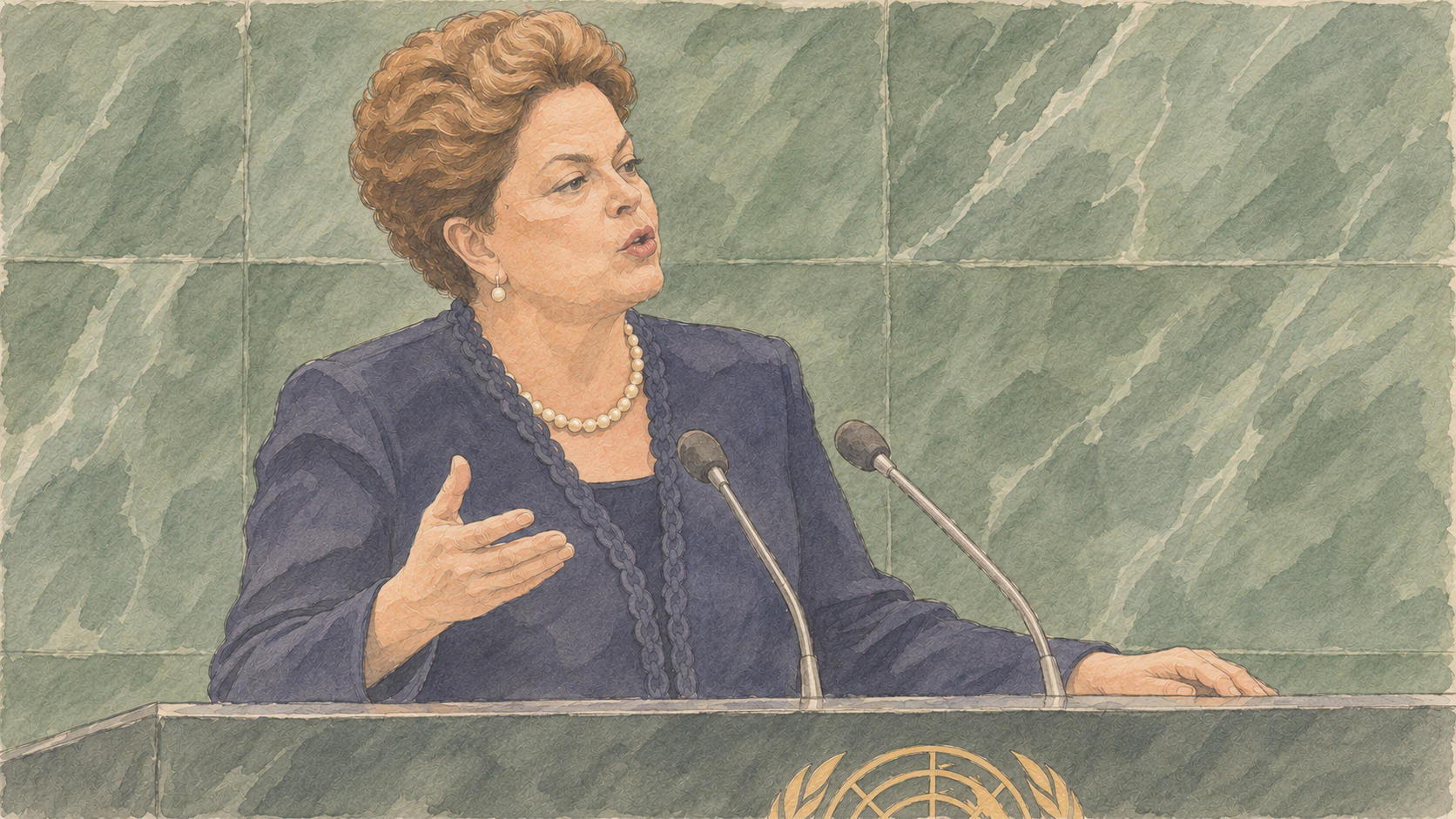
Mrs Rousseff and her staff should be thankful that Brazil’s speech is traditionally the first to happen. Rather than addressing to a multitude of chiefs of state and diplomats while they are bored, she was able to press her point more enthusiastically. Among her arguments, there was a brief reference to the terrorist attack in Kenya, the expected repudiation of NSA’s illegal espionage activities and a plead for a diplomatic solution of the Syrian crisis. Given the importance of several of the subjects discussed by Dilma, it is essential to recognise how her words suffice to illustrate Brazil’s near-term international aspirations. This article will highlight major parts of the speech, as well as comment on its intentions.
“Allow me initially to express my satisfaction in having a renowned representative of Antigua and Barbuda – a country that is part of the Caribbean, which is so cherished in Brazil and in our region – to conduct the work of this session of the General Assembly. You can count, Excellency, on the permanent support of my Government.
Allow me also, at the beginning of my intervention, to express the repudiation of the Brazilian Government and people to the terrorist attack that took place in Nairobi. I express our condolences and our solidarity to the families of the victims, the people and the Government of Kenya.
Terrorism, wherever it may occur and regardless of its origin, will always deserve our unequivocal condemnation and our firm resolve to fight against it. We will never give way to barbarity”
The president begins by complimenting Mr John Ashe, a representative from the Caribbean who was in charge of the General Assembly that day. More than a matter of respect, it also shows that we are committed to maintaining a peaceful relation with our neighbours. Also, when the terrorist attack in Nairobi is mentioned, its reference serves to introduce Brazil’s denial of supporting terrorist activities. That is an appropriate way of saying: our policy is to reprimand every act which involves the suffering or death of innocent people. Indeed, one should note a hint of criticism in Rousseff’s words, after all, there are countless ways to negatively affect civilians – many of them currently carried out by some states.
“I would like to bring to the consideration of delegations a matter of great importance and gravity. Recent revelations concerning the activities of a global network of electronic espionage have caused indignation and repudiation in public opinion around the world.
In Brazil, the situation was even more serious, as it emerged that we were targeted by this intrusion. Personal data of citizens was intercepted indiscriminately. Corporate information often of high economic and even strategic value – was at the centre of espionage activity. Also, Brazilian diplomatic missions, among them the Permanent Mission to the United Nations and the Office of the President of the Republic itself, had their communications intercepted.”
There is no better subject to initiate the debate at the General Assembly than the indignation over American insolent spy program – issue that has not even been discussed by Barack Obama. This abusive act has been characterized as “a matter of great importance and gravity” when, in fact, it is the greatest spy scandal since the end of the Cold War. Not only has a global power taken advantage of its technology to acquire commercial secrets (notably, information about oil exploration), but it has focused on a regional ally in South America. Dilma expects to be apologised by the US government, although this scenario is unlikely to ease tensions between both nations.
“As many other Latin Americans, I fought against authoritarianism and censorship, and I cannot but defend, in an uncompromising fashion, the right to privacy of individuals and the sovereignty of my country. In the absence of the right to privacy, there can be no true freedom of expression and opinion, and therefore no effective democracy. In the absence of the respect for sovereignty, there is no basis for the relationship among Nations”
Our diplomatic service should be praised for its clever attempt to relate NSA’s espionage to two different situations: Rousseff’s personal experience combating a dictatorship and American ideals about democracy. They were able to counter-attack the Obama administration by associating one of the most traditional international policies that the United States has adopted with their own action towards other countries. Moreover, when the president evokes her individual thoughts on the problem, she adds a human tone of voice to an already logically constructed argument. Consequently, she captivated her audience and, at the same time, appealed to their conscience.
“The United Nations must play a leading role in the effort to regulate the conduct of States with regard to these technologies. For this reason, Brazil will present proposals for the establishment of a civilian multilateral framework for the governance and use of the Internet and to ensure the effective protection of data that travels through the web.”
Throughout this part of the speech, Dilma has simply stated the obvious. The Internet is controlled by a set of enterprises which consists of an oligopoly. Also, as these corporations have their roots on just some countries, it is harder to control the Web in a global scale. The creation of an organism responsible for governing the virtual world seems to be a feasible option, because it would mean extending democracy to a higher level. It is important to notice that this proposal was not devised by Brazil – it already existed, but had been rejected.
“The major step taken in Rio de Janeiro was to place poverty in the centre of the sustainable development agenda. Poverty is not a problem exclusive to developing countries, and environmental protection is not a goal to achieve merely once poverty is overcome.” *[Rio+20 – environmental conference that happened in Rio last year]
A feeble excuse disseminated over Rio+20 was that global powers could not afford to spend money protecting nature while they were recovering from a financial crisis. However, one more time, a chief of state acknowledges the need for combining environmental efforts with socioeconomic ones. Rousseff has not presented arguments to support her thesis, due to the inexistence of them. There is no practical way of displaying the benefits of keeping social investments during an economic slump. This is best expressed by the reduction of social security in Europe, continent that also suffers from ageing populations.
“We reiterate our support, Mr President, for the reform of the IMF. Governance of the Fund should reflect the weight of emerging and developing countries in the world economy. Delaying this reform will further reduce the Fund’s legitimacy and effectiveness.”
“It is imperative to avoid the collective defeat of reaching 2015 without a Security Council capable of fully exerting its responsibilities in today’s world. The limited representation of the UN Security Council is an issue of grave concern, considering the challenges posed by the 21st century. The immense difficulty in offering a solution to the Syrian crisis and the paralysis in addressing the Israeli-Palestinian conflict exemplify this concern.”
“In dealing with important issues, the recurring polarization between permanent members generates a dangerous paralysis. We must provide the Council with voices that are at once independent and constructive. Only the expansion of the number of permanent and non-permanent members and the inclusion of developing countries in both categories will correct the Council’s deficit of representation and legitimacy.”
Dilma Rousseff is poised to reaffirm Brazil’s intentions of having a decisive role in the establishment of a new world order. Although she does not specifically refer to the country, it is clear that the president criticizes: the exaggerated power of developed nations in the IMF; the ineffectiveness that has affected the UN Security Council in its latest meetings; the absence of an international agency which truly represents today’s developing nations. Kofi Annan, throughout his tenure as secretary-general of the United Nations, unsuccessfully tried to conduct a reform of its institutions. Since then, this idea has been forgotten, even though there are countries willing to advocate it.
“[discussing about the possibility of a military strike in Syria] Whatever the case, we repudiate unilateral interventions contrary to International Law, without Security Council authorization, which would only worsen the political instability of the region and increase human suffering. In the same vein, a durable peace between Israel and Palestine takes on new urgency in view of the changes occurring in the Middle East.”
Rousseff ends her speech with a proposal for a peaceful solution to the chaos in Syria. This is expected from Brazil, which has an enduring tradition of trying to resolve global issues via diplomatic channels. Additionally, following what former president Lula did when he went to another General Assembly, Dilma has defended the right of Palestinians to have their own state. On the other hand, as there were other things to be discussed, the issue regarding Arab-Israeli conflicts was left aside.
In brief, the president’s speech summarised almost all of the subjects that are currently prioritised in our external policy. Of course, Dilma is not an expert in diplomacy, so her words must have been prepared by other people. This does not mean that she has no credit over her achievements in New York. Actually, if there is a woman in Brazil who is ready to face representatives from more than 150 nations, it is the second most powerful woman in the world, according to Forbes.
Note: If you would like to read Rousseff’s entire speech, please click on this link.
Originally published on thimabi.wordpress.com.